Robotics Center of Silicon Valley
A DeepAware company. The deployment layer for physical AI — from the hardware on your bench to the evaluation that gets a policy into production.
Our Mission
Make physical AI development practical — absorb the complexity between research demos and real-world robot deployments.
Research teams can assemble world-class robot learning stacks, but integrating hardware, collecting high-quality demonstration data, running fleet teleoperation, and keeping robots operational is still the bottleneck that separates demos from deployments. SVRC exists to absorb that complexity.
We believe the next decade of robotics progress will be defined by three forces: abundant, diverse, real-world data; shared infrastructure that lowers the cost of experimentation; and operator-friendly systems that let domain experts teach robots without writing code.
What We Do
Hardware
Curated catalog of humanoids, arms, quadrupeds, dexterous hands, and teleoperation kits. Transparent pricing, demo-ready configs, and ongoing support. Buy or rent.
Browse store →Data Collection
Custom data programs for imitation learning, RL, and VLA pretraining. Delivered in LeRobot, RLDS, and HuggingFace formats with rich metadata and QA.
Data services →AI Training
RL environments, benchmarks, and model fine-tuning infrastructure. From simulation to deployment-ready policies across manipulation and locomotion tasks.
RL environments →Deployment
Fleet teleoperation for robots in restaurants, logistics, research, and retail. Low-latency streaming, multi-arm control, and human-in-the-loop intervention.
Data platform →Founder
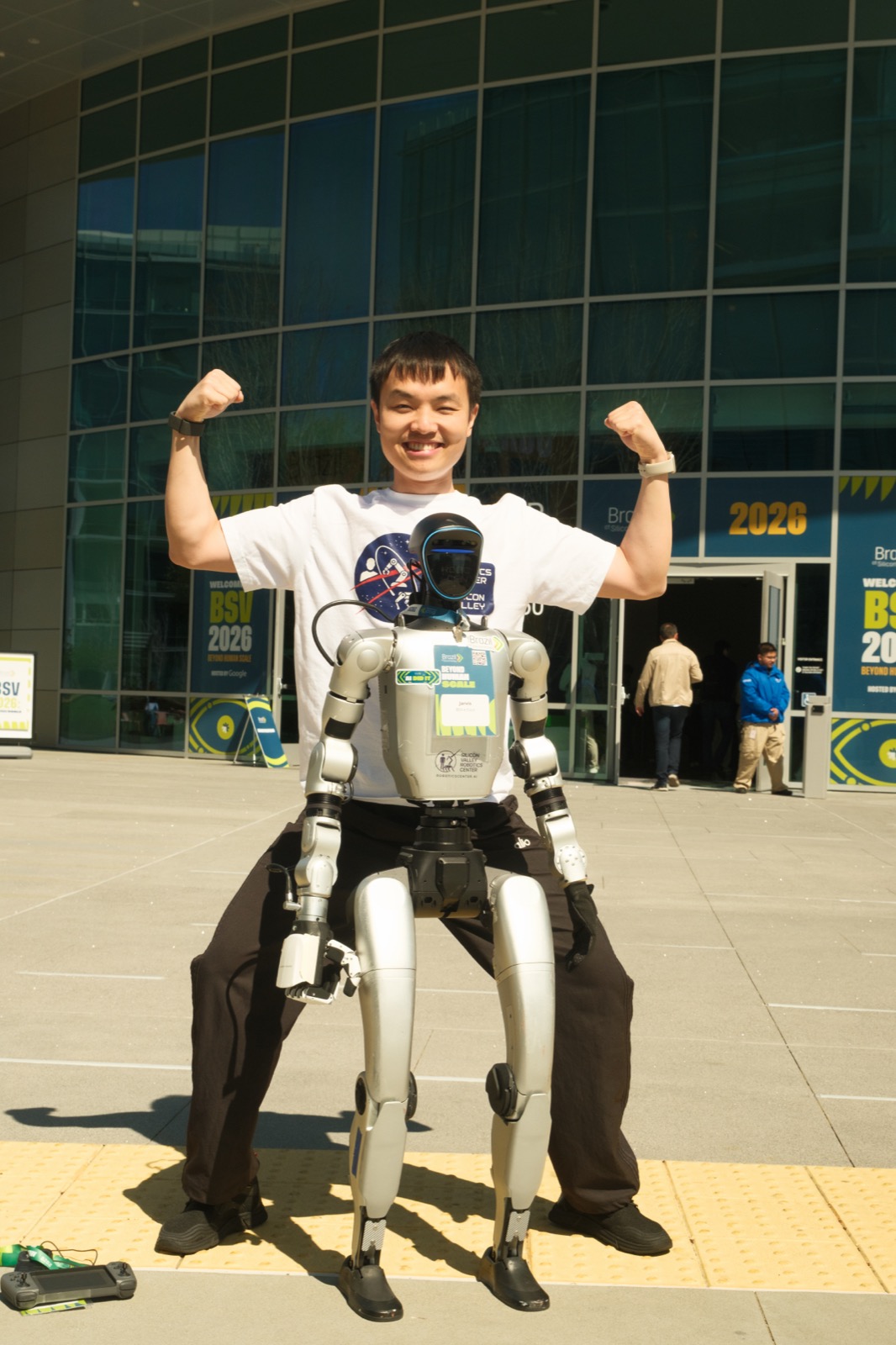
Jerry Huang
Jerry is building the infrastructure layer for physical AI. He founded SVRC to solve the practical bottleneck between research demos and reliable robot deployments — the hardware procurement, data collection, fleet operations, and tooling that no one was selling as a coherent stack. SVRC is backed by Y Combinator (S25) and is a member of the NVIDIA Inception program.
Our Locations
Both sites are open to partners, customers, and collaborators by appointment. We host regular demo days and community meetups.
San Francisco, CA
90 Welsh StSan Francisco, CA 94107
Showroom, teleoperation control room, training bay, and repair shop. A short drive from Stanford, Google, and the Bay Area robotics ecosystem.
Boston, MA
125 Western AveAllston, MA 02134
Within reach of MIT, Harvard, and the Boston University robotics community.
How We Work
Operator-focused, software-enabled. Every engagement starts with a scoping conversation and ends with a clear deliverable.
We produce a written plan, pricing, and shipping schedule before work begins. Customers have direct Slack or email access to the engineers running their project, and every dataset, rental, or purchase is backed by a clear warranty and refund policy.
Customers with custom data engagements receive read-only dashboard access to their own operations so they can audit progress, quality metrics, and delivery timelines in real time.
Operating Principles
- Write it down. Every scoping conversation, decision, protocol, and incident is documented. If it is not written, it is not a plan.
- Be specific. Dataset sizes, teleop hours, robot uptime, and milestones are tracked as numbers, not adjectives.
- Ship real hardware. Software-only mentalities do not work in robotics. We invest in the unglamorous parts that make the glamorous parts possible.
- Stay vendor-neutral. A customer-first recommendation may send a purchase to a competitor. We would rather be trusted long term.
- Respect the field. The robotics community is smaller than you think. We cite papers, attribute ideas, and never claim research as our own unless we did it.
The Showroom
Hands-on access to real robots — not PDF spec sheets.
Most robotics hardware is sold through quote-driven procurement. Buyers commit tens or hundreds of thousands of dollars to a platform they have never touched. Our San Francisco showroom exists to fix that. Power up, teleoperate, and in many cases drive a robot yourself. Walk the bay with an engineer who has shipped dozens of the same unit and ask direct questions about failure modes, firmware quirks, and real-world maintenance.
The same floor doubles as our training bay and staging area for customer shipments. Visitors often ask if it is a research lab — it is a working commercial facility that happens to look and feel like one.
Data Collection Operations
Task-specific cells with synchronized sensors, QA stations, and real variability.
A typical cell has multiple synchronized cameras, a teleoperation rig, force-torque sensing, and options for tactile gloves, motion capture, or gaze tracking. Every cell has an adjacent QA station where episodes are reviewed before delivery.
We think hard about dataset diversity. Two hundred episodes of the same operator, same task, same location are less valuable than two hundred with real variability in operator, scene, distractors, and camera angle. Our protocols encode that variability explicitly.
Fleet Teleoperation
Skilled operators, low-latency links, and an observability stack that flags problems in real time.
Our teleop control room is built around dedicated fiber, multi-screen operator stations with redundant input devices, and monitoring that flags latency spikes, dropped frames, or unusual behavior in real time. Operators are cross-trained on multiple hardware platforms.
The hardest part is not technical — it is workforce. We treat operators as skilled professionals, invest in training and career development, and compensate them accordingly. Reliable long-term operators are the difference between a fleet that runs smoothly and one stuck on edge cases.
Open Knowledge & Open Source
Robotics moves faster when knowledge circulates.
We publish a weekly research digest, maintain a glossary for newcomers, and open-source teleoperation tooling and collection protocols. Our state-of-robotics reports cover global trends and country-specific markets, free to anyone.
We benefit from open-source robotics software — ROS, LeRobot, MuJoCo, Isaac Sim, OpenCV, PyTorch — and give back with upstream bug fixes, feature requests, and public tooling. We do not release code for show; we release it because the field moves faster when tooling circulates.
Who We Serve
Academic labs, early-stage startups, Fortune 500 automation groups, educators, and journalists. Each has different needs — from configuration advice and graduate student onboarding, to fast turnaround on broken hardware, to vendor-agnostic fleet recommendations.
We are candid about what we are and are not. Not a foundation model lab, not a manufacturer, not a venture studio. We are an operator-led company whose revenue comes from customers who pay for value delivered.
Learn More
Meet Our Team
Cross-disciplinary team spanning robotics engineering, ML research, operations, teleoperation, and education.
View team →Credentials & Recognition
Industry memberships, academic partnerships, press coverage, and verified affiliations.
View credentials →Partners
Hardware manufacturers, academic labs, and industry collaborators across the robotics supply chain.
View partners →Trust & Policies
Refund, warranty, shipping, privacy, security, and compliance policies in one place.
View trust hub →Contact Us
Building a physical AI product? We would like to help.
Book a Call
San Francisco
90 Welsh St
San Francisco, CA 94107
Boston
125 Western Ave
Allston, MA 02134